
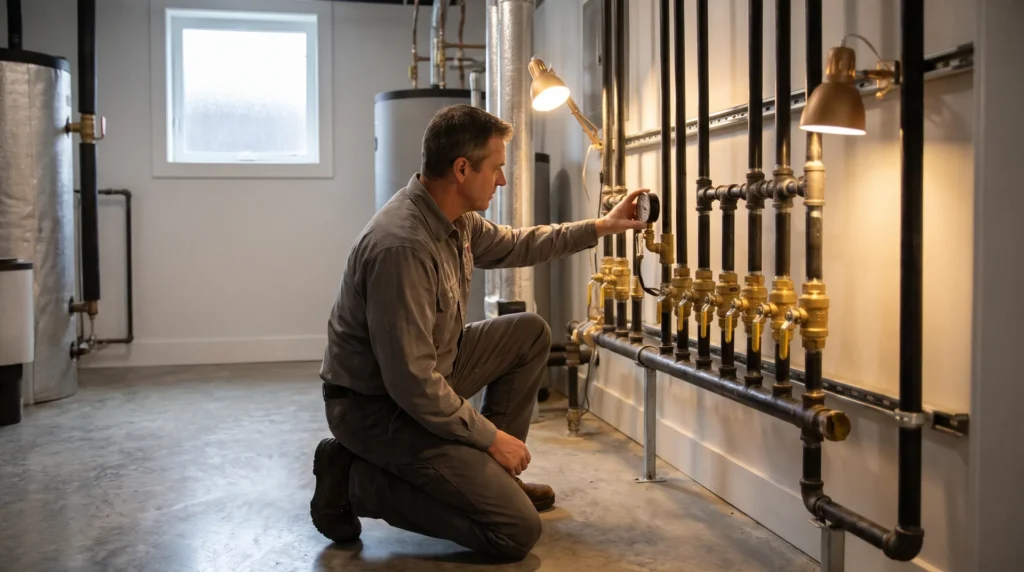
Deciding between gas line repair and replacement comes down to fault isolation, pipe material age, and code compliance. A localized gas line repair ($150-$800) is appropriate when a pressure test confirms a single leak at an accessible fitting on a pipe under 30 years old. Full or partial gas line replacement ($1,500-$6,000+) is required when piping is over 40-50 years old, exhibits widespread corrosion, involves unbonded or arc-damaged yellow CSST, or lacks the BTU capacity required under Alberta’s CSA B149.1:25 installation code.
Whether flagged during a real estate inspection, discovered during a furnace upgrade, or detected via a sudden pressure drop, a compromised gas line requires immediate attention. Property owners often rely on licensed plumbers in Alberta to evaluate these systems, but understanding the engineering, regulatory, and cost factors helps you make an informed decision.
Gas Line Repair vs. Replacement: At-a-Glance Comparison
When evaluating a gas line fault, technicians assess the system against strict safety criteria to determine if a spot fix is viable or if a partial or full replacement is mandatory.
|
Decision Factor |
Choose Localized Gas Line Repair |
Choose Gas Line Replacement (Partial or Full) |
|---|---|---|
|
Leak Profile |
Single minor leak at one accessible fitting, valve, or threaded joint (Repipe Solutions Inc.). |
Multiple leaks detected during a pressure test, or two or more leaks within 12 months (Specialized Plumbing). |
|
System Age |
Piping system is under 15-30 years old and structurally sound. |
System is 40-50+ years old, especially pre-1980 unlined steel or black iron (HomeFixx). |
|
Material Condition |
Clean black iron or properly bonded CSST with isolated mechanical damage. |
Pitting corrosion, flaking galvanized steel, unbonded yellow CSST with arc risk, or brittle joints. |
|
Capacity / Load |
Existing pipe diameter supports total BTU load of all connected appliances. |
Adding high-demand appliances (tankless water heater, garage unit heater) that exceed existing line capacity. |
|
Typical Cost Range |
$150 – $800 (up to $2,300 if underground excavation is required) (Fixr). |
$1,500 – $6,000+ for whole-home repipe or new branch lines in Alberta (Canada Construction Network). |
How Pipe Material and Age Influence the Choice
A major driver of the repair versus replacement decision is the piping material itself. Different generations of homes feature distinct gas piping materials, each with specific failure modes.
Black Iron (Rigid Threaded Steel)
Black iron gas pipe inside a dry Alberta basement can last 50 to 75 years, whereas buried black iron exposed to soil moisture and frost heave can corrode in just 20 to 30 years. When replacing underground gas lines in Alberta, licensed gasfitters install high-density polyethylene (HDPE) piping buried to a minimum depth of 600 mm (24 inches) under yards and 750 mm (30 inches) under driveways, offering a corrosion-free lifespan of 50 to 100 years.
While rigid black iron is durable, common failure points include thread corrosion, dried sealant, and structural sagging. Older pipe dope dries out over decades, creating micro-leaks at elbows and tees. Usually, a single leaking joint on a sound black iron manifold can be repaired by cutting out the section or re-threading and sealing it.
Corrugated Stainless Steel Tubing (CSST)
CSST boasts a lifespan of 50 to 75+ years. However, unbonded yellow CSST is highly vulnerable to electrical arcing and mechanical abrasion. If lightning strikes near a home, voltage can energize metallic systems and arc across unbonded yellow CSST, burning microscopic pinholes straight through the tubing wall (Maryland Public Service Commission).
As noted by Wesley Upchurch of Upchurch Inspection in 2026, a lightning event can cause a pinhole leak in unbonded CSST that slowly fills the structure with gas without immediate detection. Unlike black iron, damaged or arc-pitted CSST cannot be patched or taped; the compromised run between fittings must be fully replaced. Modern arc-resistant black-jacketed CSST is now the standard to disperse electrical energy and reduce arc-puncture risk.
When Appliance Upgrades Force a Replacement
Frequently, homeowners attempt to simply extend an existing half-inch or three-quarter-inch gas branch line for a new garage heater, BBQ, or tankless water heater. Unfortunately, the existing trunk line often cannot supply the required British Thermal Units (BTUs) without starving the primary furnace.
Before undertaking any gas-related home improvement, property owners must verify if their existing gas line can handle another appliance. If a full BTU load calculation reveals the existing manifold is undersized, a full line replacement or a dedicated new branch line from the meter is required.
Alberta Regulatory and Code Updates in 2026
Code compliance pushes many projects from a quick patch to a formal replacement or engineered modification. Gas work is strictly regulated, highlighting why hidden gas leaks are among the plumbing problems you should not try to fix yourself.
In Spruce Grove, Alberta, any installation, alteration, or addition to a gas piping system requires a municipal gas permit under Safety Codes Services Permit Bylaw C-1389-25 and must comply with the CSA B149.1:25 Natural Gas and Propane Installation Code (in force as of March 1, 2026). While additions of 6 metres (20 feet) or less operating under 0.5 psig may qualify for targeted leak testing under STANDATA 25-GCE-001, larger replacements and new runs, such as a $2,500-$6,000 underground polyethylene line to a detached garage, require full pressure testing and a Safety Codes Officer inspection.
The 2026 updates to CSA B149.1:25 also strictly align gas piping bonding requirements with the Canadian Electrical Code. If an older CSST installation is unbonded, a licensed contractor must bring the bonding up to code during any system alterations.
Cost Breakdown for 2026
Understanding local market rates helps set expectations for your upcoming project.
Gas Line Spot Repairs
-
Diagnostic Pressure Test: $95 to $150+. A standalone manometer test pinpoints whether a system holds pressure or suffers from systemic loss, preventing unnecessary full repipes.
-
Minor Interior Spot Repair: $150 to $800. This includes tightening a threaded joint, replacing a faulty shut-off valve, or swapping a short accessible section of pipe.
-
Underground Leak Repair: Up to $2,300+, driven largely by hydrovac or trenching excavation costs.
If you require an isolated plumbing repair in Spruce Grove, these spot fixes are typically completed in a single visit without requiring extensive structural teardowns.
Gas Line Replacements and New Installations
-
Full Interior Home Gas Repipe: $1,500 to $6,000+ (up to $8,000 for large custom homes with finished drywall access challenges).
-
Natural Gas Line to Detached Garage: $2,500 to $6,000. Trenching alone for a residential run ranges from $1,500 to $4,500 depending on depth and terrain.
-
Tankless Water Heater Gas Upgrade: $3,500 to $6,500. This reflects mandatory certified gasfitter labour, upsized gas supply lines, and extreme-cold venting rated for deep winter temperatures.
Keep in mind that utility service upgrades also fluctuate by season. Effective January 1, 2026, ATCO Gas charges $1,047 in summer and $1,350 in winter for a standard urban service line upgrade, emphasizing the value of proactive summer replacements.
Gas Line Installation in Spruce Grove
For a gas line installation in Spruce Grove, the work must be performed by a certified gasfitter or plumber holding a municipal business license under a valid gas permit. DIY gas line work is strictly prohibited in Alberta for unpermitted alterations. Homeowners and commercial property managers looking to install lines for basement fireplaces, detached garage heaters, or BBQs must adhere to a strict municipal workflow.
As a licensed plumbing, heating and mechanical contractor, Flawless Flows Mechanical manages professional gas line services in Spruce Grove using a comprehensive, code-compliant approach:
-
Total BTU Load Calculation: Evaluating all existing appliances (furnace, hot water tank, range) plus the new appliance to verify the existing manifold and gas meter can support the demand without a pressure drop.
-
Permitting and Utility Locates: Pulling the City of Spruce Grove gas permit via the CityView Portal and scheduling Alberta One-Call utility locates prior to any underground trenching.
-
Material Selection and Routing: Installing threaded black iron, properly bonded arc-resistant CSST for interior runs, or buried HDPE poly pipe at a 600 mm to 750 mm depth for underground garage runs.
-
Pressure Testing and Inspection: Pressurizing the line in accordance with CSA B149.1:25 and STANDATA 25-GCE-001 to verify zero leaks prior to the City Safety Codes Officer sign-off and appliance commissioning.
Flawless Flows Mechanical utilizes a diagnostic-first methodology, never guessing or pushing an unnecessary full repipe without running a pressure test and electronic leak detection first. They also provide 24/7 emergency response and back their installations with a one-year workmanship warranty.
Final Thoughts on Your Gas Line Infrastructure
Navigating a gas line repair or replacement requires more than just stopping a leak. It demands a holistic look at material age, system capacity, and the latest CSA installation codes. Whether you are dealing with a minor thread leak on a 15-year-old black iron pipe or facing a mandatory upgrade due to unbonded CSST, safety and precision must lead the way. Partnering with a licensed local expert ensures your system runs safely and efficiently for decades to come.